The Optics of Glow: What's Really Inside Those Bottled Light Formulas
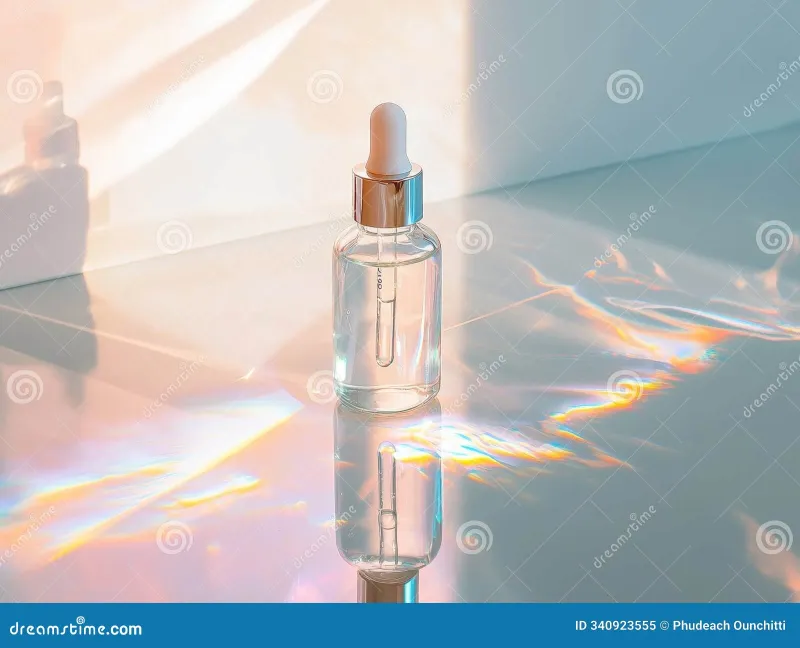
Photo: glass skin serum bottle light reflection beauty product macro, via thumbs.dreamstime.com
Walk any American beauty aisle—from Sephora to the drugstore shelf—and the vocabulary is uniform: glow, luminosity, lit-from-within, glass skin. The language of light has colonized skincare marketing so thoroughly that it is easy to forget the phrase describes a physical phenomenon. Light, after all, does not negotiate with adjectives. Either it reflects, or it does not.
So we asked the question the packaging avoids: when a formula promises radiance, what is actually happening at the surface of the skin? The answer splits cleanly into two camps—ingredients that change the skin, and ingredients that change how light behaves on it.
The Biology Camp: Ingredients That Earn Their Glow
Niacinamide, the workhorse form of vitamin B3, is the closest thing skincare has to a legitimate luminosity engine. Clinical research supports its role in strengthening the barrier, regulating sebum, and fading pigmentation over weeks of consistent use. It does not reflect light; it improves the surface so that light reflects better. The distinction matters. Niacinamide's glow is earned, cumulative, and real—typically visible at concentrations around five percent after eight to twelve weeks.
Chemical exfoliants operate on similar logic. Glycolic and lactic acids remove the layer of dull, dead cells that scatter light irregularly. The result is smoother optical terrain. Alpha-arbutin and vitamin C derivatives, meanwhile, address the uneven pigment that reads as shadow rather than radiance.
The Optics Camp: Chemistry That Borrows the Light
Then there is the second, more theatrical category. Pearl extracts and mica—the minerals behind decades of highlighters—work by physically bouncing light. Finely milled, coated particles sit on the skin's surface and create a soft-focus scattering effect that the eye interprets as luminosity. It is not biology. It is physics, deployed cosmetically.
Blurring silicones such as dimethicone and its cousins fill in micro-texture and fine lines, creating the temporarily smooth plane that reflects light uniformly. This is why a 'glow serum' can deliver visible results in minutes: it is performing a cosmetic optical illusion, not transforming skin. There is no dishonesty in this—makeup has always worked this way—but the distinction between instant optics and genuine improvement is precisely where marketing blurs.
Increasingly, formulators straddle both camps. A serum may pair niacinamide with a light-diffusing pearl derivative, offering immediate visual payoff while the biological work proceeds underneath. Read closely, many of the season's most-hyped 'glow' launches are exactly this hybrid: a promise of now and later in one bottle.
Reading the Label Like an Investigator
For the American shopper, three questions cut through the vocabulary. First, does the formula list proven actives—niacinamide, vitamin C, AHAs—at meaningful concentrations? Second, does it contain optical agents—mica, silica, pearl powder—that will produce immediate but temporary sheen? Third, and most importantly, does the marketing distinguish between the two?
Products that conflate the two are not necessarily poor performers. But a consumer who understands the difference can calibrate expectations: the pearl-infused formula will glow tonight; the niacinamide will glow in March.
So—Biology or Chemistry?
The honest answer is both, and the industry's collective embrace of light language reflects a genuine optical truth. Radiance is not a mystical property. It is the measurable behavior of photons meeting a well-hydrated, even, protected skin surface. Some ingredients build that surface over time. Others dress it for the evening.
The most intelligent routine, as the seasons turn toward the low, amber light of fall and winter—when American complexions lose their summer luminosity fastest—uses each for what it is. Build the biology. Borrow the optics when you need them. And reserve skepticism for any bottle that claims to do both without telling you which is which.