Thirty Thousand Feet, Zero Humidity: The Frequent Flyer's Guide to Landing With Light Still in Your Skin
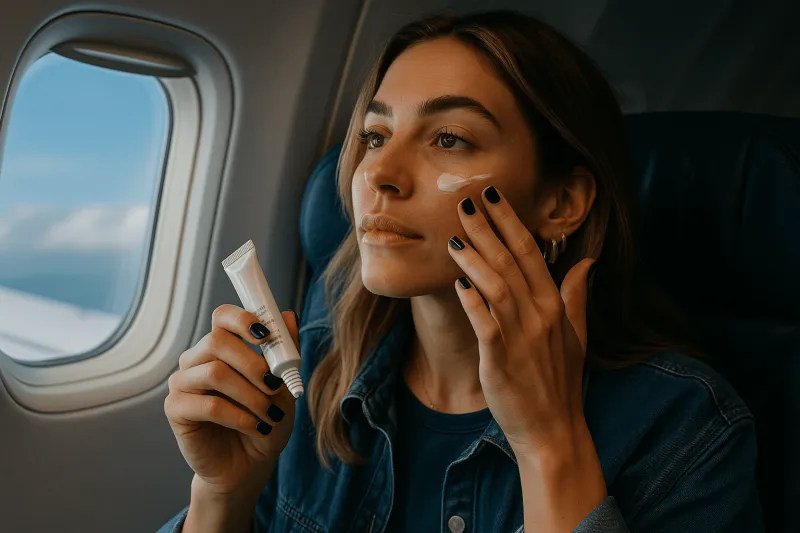
Photo: woman applying moisturizer on airplane skincare routine window seat, via 1883magazine.com
There is a particular moment, usually somewhere over Kansas, when a frequent flyer feels it: the tightness across the cheeks, the faint pull at the corners of the eyes. It is not fatigue, exactly. It is dehydration, engineered. Commercial aircraft cabins are pressurized to simulate an altitude of around 6,000 to 8,000 feet, and the humidity in that environment routinely drops below 20 percent—drier than most of the American Southwest on an August afternoon. For the roughly 2.6 million passengers who pass through U.S. security checkpoints on an average day, that means every flight is a low-grade assault on the skin barrier.
At Luce, we think of radiance as a matter of light—how it lands on the face, how it scatters through a well-hydrated surface. Stripped skin does not scatter light. It absorbs it, flatly. Which is why the beauty toll of America's flying culture deserves more attention than it gets.
What Recirculated Air Actually Does
Dr. Elena Marsh, a board-certified dermatologist in Chicago who counts more than a few consultants among her patients, describes the cabin as "an evaporative chamber." The air is drawn through the compressor system, heated, and mixed with outside air that holds almost no moisture. Transepidermal water loss accelerates accordingly. "In a two-hour flight, you can lose more water through the skin than you would across an entire dry winter day at home," she says.
The consequences compound. Dehydrated skin looks duller because dry corneocytes scatter light unevenly. Oil production can rebound to compensate, which is why some passengers deplane with a shine in the T-zone and flaking at the jawline—depletion and excess on the same face. Add red-eye timing, when lymphatic drainage slows and fluid pools around the eyes, and you get the puffiness that no under-eye concealer fully disguises.
There is also the matter of what you touch. Tray tables, armrests, seat-back pockets—the commonly cited surfaces of the modern aircraft—are not places for fingers that will later press a serum into the cheek. Dermatologists are unanimous on this point: hands off the face at altitude.
Three Flyers, Three Rituals
The consultant. Maya R., a strategy consultant who flies out of Dallas–Fort Worth twice a week, treats her seat 14C like a second vanity. Her kit is minimal by design: a hydrating mist, a ceramide-rich moisturizer in a travel-size tube, and a lip treatment she reapplies without ceremony. "I used to land looking like I'd aged five years in two hours," she says. "Now I land looking like I took a nap. It changed how I show up in the first meeting."
Her routine is deliberately unglamorous. Mist, moisturize, mist again. She skips makeup on travel days, which she admits took professional courage. "Everyone at the gate is dehydrated together. It's the great equalizer."
The flight attendant. Twenty-two years in the cabin taught Denise O. what no marketing campaign could. Crew members pressurize and depressurize more times in a month than most passengers do in a year, and their skin pays the tax. Her non-negotiables: hydration begins the night before a trip, not at the gate. She drinks water aggressively twenty-four hours ahead, applies a heavier occlusive layer before long-hauls, and—her one indulgence—keeps a refrigerated gel eye mask in her crash kit for layovers. "The cabin takes from you constantly," she says. "You have to bank moisture in advance."
The wedding guest. Not every flight is business. Jake T. flies the New York–to–Austin corridor for weddings, reunions, and the occasional bachelor weekend, and he used to arrive looking like a man who had slept in an airport. His fix is structural: he books the earliest flight, does his full routine the night before rather than the morning of, and carries a single product—yes, one—a hyaluronic acid serum he applies mid-flight and again before the rehearsal dinner. "The night-before routine matters more than the plane routine," he insists. "You can't fix a flight-dehydrated face in the bathroom mirror at the hotel."
The Two-Minute Seat-Back Ritual
For those without a consultant's carry-on or a flight attendant's decades of practice, Dr. Marsh offers a compressed protocol that fits between the seatbelt sign and the beverage service:
- Cleanse your hands, not your face. A hand sanitizer or sanitizing wipe for the fingers. The face stays untouched.
- Mist or dampen. A hydrating mist with humectants—glycerin, hyaluronic acid—applied in two light passes. If you brought nothing, a splash of bottled water on a tissue pressed to the cheeks works in a pinch.
- Seal immediately. Humectants without an occlusive layer lose moisture to the cabin air faster than they deliver it. A pea-sized amount of ceramide moisturizer, pressed rather than rubbed, locks the water in.
- Lips and eyes last. A balm for the lips; a fingertip tap of moisturizer beneath the eyes, never dragged.
- Hydrate from within. One glass of water per hour of flight, offsetting the alcohol and coffee that quietly deepen the deficit.
Two minutes, four products at most, zero drama. Done twice on a coast-to-coast flight, it is the difference between a face that scatters light and one that swallows it.
The Landing Day Principle
The final insight our three flyers share is counterintuitive: the most important routine happens after the seatbelt sign goes dark. Dr. Marsh recommends treating landing day as a recovery day—gentle cleanse, hydrating serum, barrier moisturizer, and a broad-spectrum SPF, since the UV exposure at altitude and through aircraft windows is real and cumulative. Skip the exfoliating acids, the retinol, the sheet-mask theatrics. A depleted barrier needs support, not stimulation.
Radiance, in the end, is not something you apply at the gate. It is something you protect at altitude, one quiet, two-minute ritual at a time.