The Lamp We Believe and the Mirror We Doubt: A Study in Private Illumination
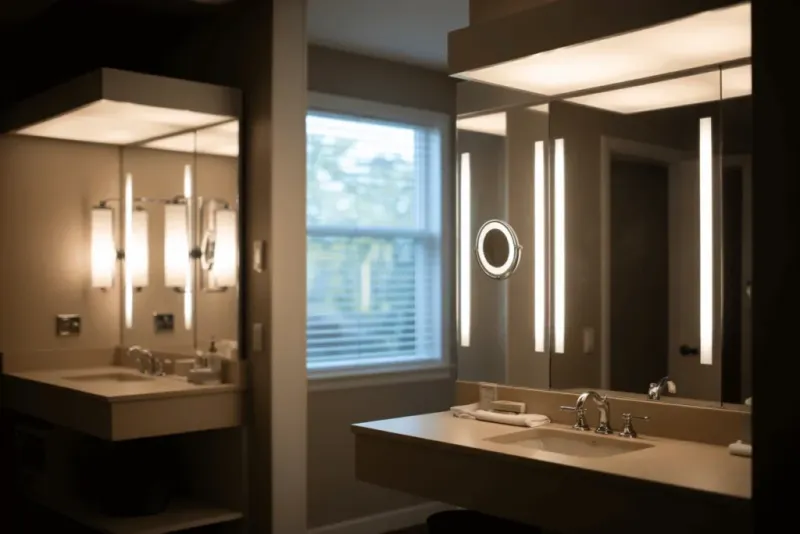
Photo: Shixart1985, CC BY 2.0, via Wikimedia Commons
Somewhere in nearly every American home, there is a negotiation happening between a woman and her light fixtures. The bathroom bulb gets swapped for a softer wattage. The overhead fixture in the bedroom goes mercifully unused. A table lamp migrates, year after year, to the precise corner of the living room where the glow falls forward across the face rather than down upon it.
No one is taught to do this. It is simply absorbed, the way we absorb the habit of angling our chins slightly upward in photographs. Ask around and the confessions arrive quickly.
The Two Reflections
"I have not turned on the bathroom vanity lights in full since 2019," admits Marissa, 42, a school administrator in Ohio. "I do my makeup by the hall light reflected in the mirror. It's softer. Kinder. When I catch myself under the real bulbs, I look like someone I don't recognize."
She is not describing vanity. She is describing a relationship — one conducted daily, privately, and almost entirely through illumination.
A lighting designer we spoke with, who has spent two decades designing residential interiors across the country, puts it plainly: "Nobody's bathroom mirror is telling them the truth. And neither is the bedside lamp. But they're telling two different truths, and women have quietly decided which one they'd rather live with."
The physics explains the preference. Overhead light rakes downward across the face, exaggerating every texture, casting small shadows beneath the eyes and along the nasolabial folds. Warm lamplight, placed at eye level or above, fills those same shadows in. The skin appears smoother, more even, more luminous — not because it has changed, but because the light has stopped testifying against it.
What the Flick of a Switch Is Really Saying
There is a temptation to read this curation as denial. The designer pushes back against that framing. "Choosing your light is not lying to yourself," she says. "It's recognizing that no single illumination is definitive. The overhead bulb is not more honest than the lamp. It's just harsher. Harshness gets confused with honesty in this culture, and I think that's worth questioning."
It is a point that lands. We have been trained to treat the unflattering reflection as the real one — the fluorescent-lit fitting room, the Zoom preview, the hotel bathroom at a rest stop off I-80. These encounters feel like verdicts. The lamp, by contrast, feels like an indulgence we haven't fully earned.
But dermatologists note that the difference between the two reflections is often marginal in reality and enormous in perception. Skin that looks crepey under a cool-toned, high-CRI bulb at close range may look entirely healthy from conversational distance under warm light. Both views are distortions. The question is which distortion we allow to shape how we feel walking into a room.
Learning to Read Light Instead of Fearing It
There is a practical takeaway buried in all this private negotiation. Once you understand what different lighting does, you stop being ambushed by it. The fitting room mirror stops being a crisis. The restaurant with the pendant lamp directly over the table becomes a known quantity, not a betrayal.
Some women have gone further, redesigning their routines around it. "I finally put a small lamp next to my bathroom mirror," says Dana, 35, a nurse in Georgia. "Side light, warm bulb. I still see my skin — all of it. I just see it the way a person standing in front of me would see it. That changed how I buy products, too. I stopped chasing things for problems that only existed under a ceiling fixture."
That may be the most useful confession of all: that the light we trust and the light we fear are both lying, just in opposite directions. The glow we seek is not found at either extreme. It lives somewhere in the middle — in skin healthy enough to look like itself under any bulb, and in the quiet confidence of a woman who has stopped letting the harshest light in the house have the final word.
The dimmer switch, it turns out, was never really about the bulb.