North-Facing Windows and the Original Beauty Ring: Reclaiming the Light Our Grandmothers Got for Free

Photo: Steve Shook from Moscow, Idaho, USA, CC BY 2.0, via Wikimedia Commons
Ask a woman in her seventies or eighties where she put on her lipstick for sixty years, and the answer is rarely a vanity. It is the kitchen window. Specifically, the one facing north.
This was not a design choice anyone made consciously. It was inherited wisdom, passed along like a casserole recipe: the north window never lies. In the era before color-corrected bulbs and LED panels, that single pane of glass gave American women the most reliable light in the house — and, without knowing it, the exact conditions that today's beauty industry spends millions engineering in a box.
Why North Light Was the Original Ring Light
The science is genuinely elegant. In the Northern Hemisphere, a north-facing window receives no direct sun. What comes through instead is skylight — diffuse, evenly scattered illumination that changes far less over the course of the day than any other exposure in the home.
Photographers have understood this for a century. Studio portraits were traditionally lit through north-facing glass because it produces what lighting designers call soft, wraparound light: illumination that arrives from a broad source, filling shadows rather than carving them. It is the same principle behind the ring light clipped to a million vanity mirrors now — a large, even source that minimizes harsh contrast.
The kitchen window accomplished this for free. No glare at noon, no amber distortion at dusk. A complexion seen in north light was seen as it was.
The Ritual at the Sink
Oral histories of mid-century American domestic life keep returning to the same scene. Women applied cold cream at the kitchen window. They checked for gray roots there. They squeezed a blackhead, inspected a new wrinkle, decided whether a shade of rouge was too strong — all in the same square of diffused daylight.
There was a practical logic beneath the habit. The kitchen was where women spent their hours, so the mirror followed the woman. But the light mattered more than convenience allowed for. Morning skincare done in north light revealed texture honestly: dry patches showed up, uneven tone declared itself, and makeup applied in that glow was calibrated to survive daylight rather than the forgiving dimness of a hallway bulb.
In a sense, our grandmothers were practicing something modern dermatology would recognize as disciplined self-examination — consistent, well-lit, unhurried observation of the skin. The kitchen window was a diagnostic station disguised as a sink.
What We Lost When We Moved the Mirror
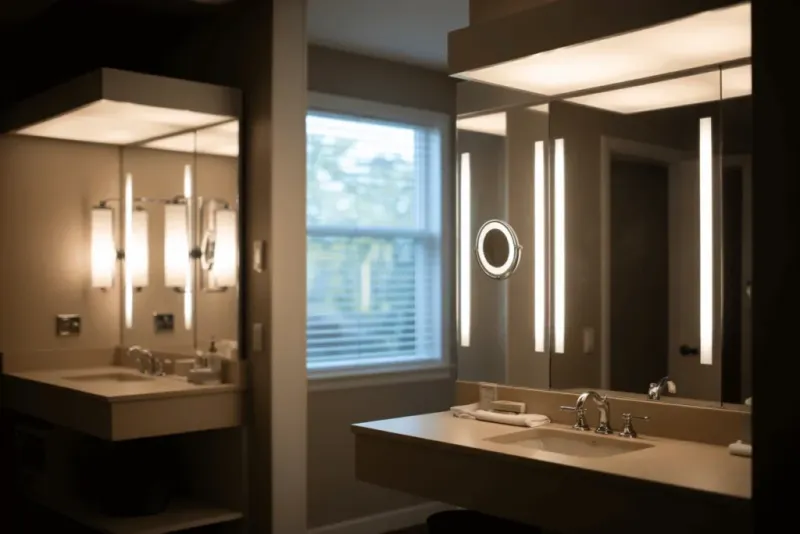
The postwar bathroom changed everything. Vanities migrated to interior walls, lit from above by incandescent bulbs that cast downward shadows and a warm, flattering haze. That haze is precisely the problem: warm light smooths and blurs, hiding the very details a morning skincare routine depends on seeing.
Anyone who has applied foundation in a yellow-toned bathroom and caught their reflection in a car visor mirror by noon knows the resulting shock. The color was wrong before the day began. The light in the bathroom was not light; it was a filter.
Modern lighting science quantifies what the kitchen window delivered instinctively. What matters for honest illumination is a high color rendering index — the ability of a light source to show colors true — combined with broad, diffused coverage and neutral color temperature. North daylight scores nearly perfectly on all three. Most residential bathroom lighting scores poorly on all of them.
Engineering Our Way Back
The current boom in vanity mirrors with adjustable color temperature, daylight-balanced bulbs, and makeup lighting that mimics 5000-kelvin daylight is, at heart, an attempt to reconstruct the kitchen window indoors. The industry is selling us back what was once an architectural accident.
There is no shame in the technology — it works, and for anyone without a north-facing window in the right room, it is the practical answer. But the nostalgic core of the old ritual is worth preserving alongside the hardware: light your face the same way, at the same time, every day. Consistency of illumination is what let generations of women track the slow, seasonal changes in their own skin. The window did not flatter, and that was the gift.
A Quiet Recommendation
If your home has one, put your mirror near the north window and do your morning routine there for a month. Notice what the honest light shows you — where your sunscreen is actually landing, where tone has shifted, where a product is working and where it isn't.
Our grandmothers were not being sentimental when they chose that window. They were being rigorous. The best light in the house was never about vanity. It was about seeing clearly, and seeing clearly is where every good skincare decision begins.