Before the Kettle Sings: The Quiet Science of the Pre-Dawn Skincare Ritual
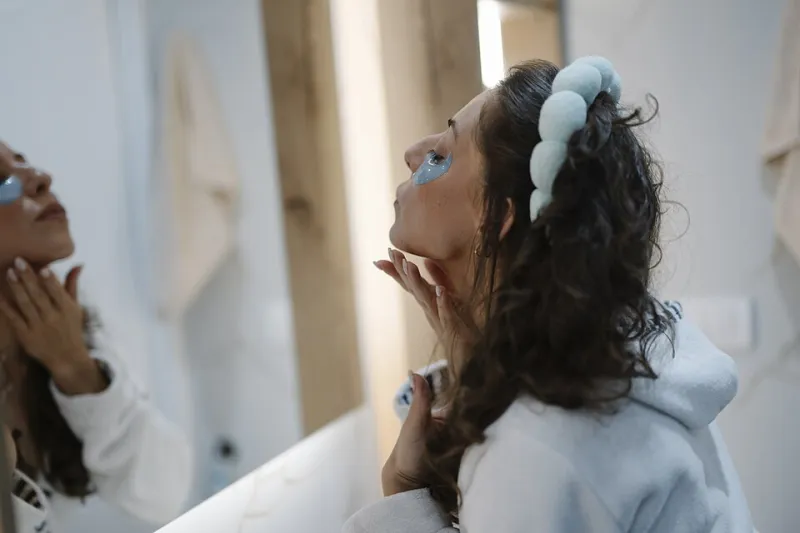
Photo: Shixart1985, CC BY 2.0, via Wikimedia Commons
At 4:45 a.m., the only light in Marisol's kitchen comes from the window over the sink, where the streetlamp across the road throws a pale trapezoid onto the countertop. She is a baker; the ovens need her before the birds do. Her serum, her moisturizer, her sunscreen—applied in that slanted, sideways glow, half in reflection off the glass of a mixing bowl she hasn't yet washed.
She is not alone. Shift nurses, distance runners, dairy farmers, airport workers: a quiet population of American women performs its entire skincare ritual in light the rest of us never see. And according to dermatologists, that light changes everything—not just how the routine feels, but how it should be done.
The Angled Light Problem
Overhead bathroom lighting—the kind most routines are built around—flatters by design. It falls straight down, filling in texture and softening shadow. Pre-dawn light does the opposite. It arrives low and lateral, raking across the face the way morning sun rakes across a field, revealing every plane and valley.
This is not necessarily bad news. "Raking light is diagnostic," explains one cosmetic chemist we spoke with. "It shows you where your skin is actually dry, where texture is building, where product hasn't absorbed." Women who apply their routine in low, angled light often develop unusually precise technique simply because they can see what overhead lighting hides.
The practical implication: if you dress your face by lamplight at 5 a.m., you are arguably better positioned to spot problems than someone applying serum under a bright vanity bar at noon.
Absorption Doesn't Wait for Sunrise
A persistent myth holds that skincare products "need daylight" to work. They don't. Active ingredients—retinoids, vitamin C derivatives, humectants like hyaluronic acid—operate on skin chemistry, not solar schedules. If anything, the pre-dawn hours offer an advantage: skin temperature is lower, sebum production has not yet ramped up, and the skin barrier, freshly through its overnight repair cycle, is at its most receptive.
There is one genuine caveat, and it involves the last step. Sunscreen applied at 5 a.m. by a night-shift worker driving home is not merely sensible—it's essential, because UVA rays penetrate cloud cover and glass from the moment the sun crests the horizon. For early risers heading toward the daylight, a morning SPF applied before dawn is still in place and working when the sun arrives. The ritual, done correctly, front-runs the exposure.
Building a First-Light Routine
For women whose days begin in darkness, the experts suggest a structure built around what little light exists:
- Choose one fixed light source. A warm porch bulb, a single kitchen pendant, a clip-on mirror light. Consistency matters more than brightness; your hands learn the geography of your face.
- Warm the products, not the room. Cold serum on cold skin at 5 a.m. feels punitive. Warming a drop of moisturizer between the palms for ten seconds improves spreadability and absorption—and doubles as a waking ritual for the hands themselves.
- Press, don't rub. In dim light, the temptation is to work quickly and heavily. Tapping and pressing product into the skin distributes it more evenly than hurried friction, and it respects the barrier at its most vulnerable hour.
- Save the mirror-check for daylight. Apply by feel and by lamp; evaluate later, in honest sun, when the low-angle light of morning will show you the truth anyway.
The Mindset of the Hour
There is a reason monastic traditions schedule their most contemplative work before dawn. The hour belongs to no one else. No emails have arrived, no one needs anything, and the routine—usually a task squeezed between shower and commute—becomes, for these women, the only truly private minutes of the day.
Marisol calls it "setting the loaf." The face, like the dough, is worked once, gently, and then left alone to rise into the day. It is a small philosophy, but it is hers, performed in the trapezoid of streetlamp light while the kettle begins, at last, to sing.